National Geographic POD

Friday, February 5, 2010

Kuala Terengannu


It was already dark as the plane took off from Kuala Lumpur on the way to Kuala Terengannu. KT is on the East coast of Malaysia, lying abreast the South China Sea. The name carries many romantic connotations. To me it conjures up an image of Chinese junks carrying the produce of the Middle Kingdom traversing the South China Sea to the Spice Islands in the South for thousands of years and acting as the highway from China to their trysts with Indian merchants travelling across the Bay of Bengal to meet them in the Indonesian Archipelago or the Malaysian peninsula..
Kuala Terengganu is the capital of a small state of Terengganu. It was founded by Chinese merchants coming to the Malay Peninsula to trade. Originally a Hindu state, it was the first area in the peninsula to accept Islam. The Malacca empire was its overlord in medieval times, but in the eighteenth century Terengganu became a separate Sultanate. This Sultanate was ruled by Siam for some time before the British made it part of the Unfederated Malay States. After a brief time under the Japanese in World War II, it was again under British rule till Merdeka ( independence) in 1957. .
The flight was short, reaching KT in about 40 minutes. The airport was small, apparently there are only about 4-5 pairs of flights every day. However like all airports in this part of the world, it was shining and reasonably efficient. Hiring a cab took just minutes and I was on the way to my hotel. I was staying at the Primula Beach Hotel where a Good Clinical Practice Workshop was being held. The hotel was nice, just off the beach and I could see the breakers ending up on the sands from the balcony of my room. This was a welcome change from the apology of a sea that you see on the West coast where the Sumatra island protects the Malaysian coast from many dangers but leaves the sea looking like a millpond. Malacca, Penang or Langkawi , nowhere does the sea look like what I am used to. KT, however has restored my faith in the Malaysian seaside !.
The entire day was spent in the workshop: lots of talking, some group exercises and food every two hours. I enjoyed all that food (not cooked by me) for the first day, but then too much food palled, I am really getting old! The evenings were free, not totally though as I was expected to read through the material that we were presented. However it was lovely to walk through a beach watching the incoming tide after many many years. I was in Chennai only last month, but I never went to the beach. There were families sitting on the beach, many picnicking. There were stalls selling corn on the cob and other snacks, Kites were available for sale and the whole atmosphere was that of good fun and games. Some young men were trying to surf, however they appeared inexpert and I don’t suppose everybody does surf like the Old spice ad in any case. The beach is apparently not suitable for swimming as the sea is rough and the sand slopes down precipitously. Nobody seemed to venture into the water, except the surfers. A vigorous game of beach football was on in one stretch of beach as children played on another part.
The monsoon is still active. You can see the pregnant monsoon clouds crossing over landwards every evening and then it starts to rain. The rain is sometimes heavy, but mostly it is a light drizzle which does not seem to disturb most activities. Everybody is used to it and enjoys the cool drenching. The entire beach front seemed to be full of restaurants. There was of course a surfeit of sea food, so that I gorged there for dinner every evening. The prawns were specially wonderful, the red and spicy curry is particularly tempting, reminding one of chingri macher jhol from back home.
It was not all fun and games: we had to appear for a test at the end of the workshop, MCQ s no less: pass marks 80%! However I am informed that I have passed, I got teh email yesterday, I heaved a sigh of relief; failing a test at this ripe old age would be humiliating to say the least and I can well imagine the glee that would ensue among many of my students if they came to know.
But all good things come to an end and so did this trip. I am now back in Kula Lumpur, back to the office and the world of protocols and cultures and publications. Next stop: Delhi and Jaipur, next weekend!

Friday, January 29, 2010

Anatomy and Dissecting Dead Bodies


The Anatomy Museum at Medical College Calcutta


Rabindranath Tagore had a tutor, Aghorenath Chattopadhyaya, who used to teach him English and several other subjects at home. This young man was a student of Medical College. Unfortunately he was apparently not a great teacher, and unlike many such teachers, was conscious of his failings. He used to desperately try to ingratiate himself to his students (who also included one of Tagore’s nephews and a brother). On one occasion he brought a dissected larynx from the Medical College in order to kindle their interest in lessons. As a treat, he also took them to the Anatomy Dissection Hall at the Medical College to see the rows of bodies lying there for dissection. Tagore, it is recorded, was not impressed. He looked upon the body of an old woman with equanimity, but the sight of a cut leg lying on the floor made him queasy.
I do not know when the present Dissection Hall at the Calcutta Medical College was built, perhaps it did not exist then, but the Dissection Hall was really a wonderful sight in my student days. There was a huge hall and a gallery above it all with rows of dissection tables and bodies in various stages of dissection. When a new term started, the doms, the attendants there, used to lay them out in rows and the bodies were now ready for the students of the two pre clinical years to get down to the serious business of dissection. One of them, Bilas Dom, whose bandy legged gait generations of students remember, has been immortalized in the unofficial Medical College anthem which we sing on many occasions, and is probably being sung there today as the reunion starts.
The hall had an adjacent museum which contained some rare specimens of congenital anomalies as well as some lovely dissections done by generations of Demonstrators and students, showing the anatomy as clearly as any picture in a textbook. The Anatomy Lecture theater was also in the same block, tiers of well polished wooden galleries rising up from the floor, the seats numbered: we were supposed to sit at in front of our numbers, to enable the teacher, or the Prosector to easily take attendance.
Dissections were divided into Parts. The first years used to do the lower limb and the thorax while the seniors in second year dissected the upper limb, abdomen and head and neck. The breast was part of the upper limb and so reserved for the seniors, worse luck! Each of these “parts” were again divided into items, for instance the dissection of the sole of the foot was the first item in the lower limb dissection. Who knew before we entered Medical College that the sole of the foot has four layers and we were supposed to remember the contents of all of them? I am sure many of us would have cheerfully exchanged our coveted medical college seats for a B Sc if we had known earlier! After each part we were supposed to give an oral examination the so called item test and our marks were recorded in a sort of report card. After you had dissected all the items, moving gradually up from the sole via the front and back of the leg to the thigh and finally the femoral triangle (much beloved of anatomists) you had to appear for a Part completion, when the entire part was open for questioning. If you successfully completed this you went to the next part.
The items were easy. The examiners were usually the demonstrators who were junior teachers, easily accessible and friendly, often preparing for post graduate examinations in the clinical sciences, brushing up their anatomy by teaching. But the Part completions were taken by the professors, those intrepid men and rarely women, who had made anatomy their life’s calling. They were much stricter and to tell the truth because we hardly ever saw them except in the safe distance of the lecture classes they evoked a fear that even the bravest students were prey to.( reading the last sentence I realize that incidentally this is the sort of English , up with which Churchill would not put, but who cares!!!)
The last three hours of each working day was given to the Anatomy Dissection. Groups were assigned to each body and we dissected the part poring over Cunningham’s manual which had guided thousands of students for decades in Indian and in England and all its colonial possessions. Initially there was fierce competition to be the dissector, but the early enthusiasm quickly evaporated and finally each group had only one or two dedicated students who actually liked to cut up dead bodies. Most of them later became surgeons, not unexpectedly!
Those were the days when anatomy was a two year course, and shared in the first year with Biochemistry and Physiology and the second year only with Physiology. Today the students do 6 subjects in the first 18 months and the anatomy teaching is a joke. Perhaps in our time there was overkill, but today we seem to have thrown out the baby with the bathwater.
Gray’s Anatomy (not the soap opera, but a huge tome, about 2.5 kg in weight) was our bible. We used to pride ourselves in knowing the origin and insertion of most of the major muscle and many minor ones and the intricate pattern of nerves, veins and arteries were endlessly fascinating. We were lucky also in having some wonderful teachers of whom I plan to write in late posts, but even without them, because we had the time to delve deeply into the intricacies of anatomy, we developed a love for it, which some called perverse.
There used to be a medal awarded for the best dissection. It was a prize examination, which meant that you had to take a special exam. My love of anatomy never extended to that sort of unhealthy levels as to take a separate non compulsory examination, so I sat out, but many did. I can’t quite recall who the Pan Medalist was in our year now. It was a prestigious award as was the prosectorship which was awarded at eh end of the first year. You got your name immortalized in marble in the Anatomy Lecture theatre as one of the rewards. ( other rewards included having to take the attendance before the classes and having to answer all the questions that lesser mortals failed to. )
Much of our knowledge was useless to our future medical career, and the students who learn Anatomy as one of six subjects in less time than we gave to only three subjects seem to do ok, but I do not think that any of them develop any fascination for the intricate network that makes up the human body that we did. In any case gross anatomy is unfashionable now, anatomist nowadays work at cellular levels.
I would like this to be a tribute to all those people whose bodies we used to learn anatomy. We , I am sorry to say, did not always treat the bodies with respect, we did not realize then, thoughtless we were, how much we owed to the persons who made their bodies available to us to educate us. May their souls rest in peace!

Sunday, January 24, 2010

Arithmetic and the Common Man.

Classical education usually excluded the knowledge of such mundane matters like numerical literacy. While the knowledge of sacred and classical texts were considered to be the epitome of knowledge, the knowledge of arithmetic was not part of the education of the upper classes, not in the early modern period in Europe, nor in India. I was reading a very interesting article about this the other day and it struck me that while the traders and businessmen obviously had to have a clear knowledge of counting and calculating, the upper classes considered this knowledge below their dignity and refrained from learning these profane arts. In fact the knowledge of arithmetic was somewhat looked down upon even in Shakespearian times and as Iago says scornfully in Othello: “great arithmetician”. Spoken about Cassio it is a term of denigration.
In early modern Britain the problem was compounded by the fact that Roman numerals were just being replaced by Arabic ones and this confused people no end. The Arabic numerals were more practical and useful, but Roman numerals were what had been used for literally more than a thousand years and this changeover could not have been easy.
However arithmetic was essential in the matters of State. The calculation of tax dues and land rents were made according to fairly complex rules and this needed calculations. The traders and administrators needed to know this, but the landlords did not. This was what made the munshi in India indispensible to the landlord and the munshi always took advantage to make money on the side. This probably was the basis of many a trading fortune!
Coming back to Britain, another problem that was faced was the crazy methods of calculation. When we were kids we knew that 20 shilling s made a pound and 12 pennies made a shilling.( or was it six?) Because it was the French who introduced the metric system, British contrariness ensured that it was well into the second half of the twentieth century before the metric system came to Britain despite its proven advantages. Not only this, they had a baker’s dozen (13), a long hundred (120) through this varied depending on the type of goods it referred to and so on.
The knowledge of addition was to some extent widespread, but subtraction. Multiplication and division apparently led to massive difficulties and many a schoolboy drowned in its difficulties. As One of Richmal Compton’s characters used to say “Latin is a language,
Dead as dead can be.
It killed the Ancient Romans
and now it’s killing me”,
so did schoolboys of those days sang .
“Multiplication is mie vexation
Division is quite as bad.
The Golden Rule is mie stumbling-stool
And Practice makes me mad,”
The onset of hand held calculators of course has put an end to such misery and today nobody (even tradesmen) do not seem to add up even 2+2 in their heads. But it is instructive to remember that there were times when such calculations were esoteric mental exercises, meant for only specialists.

Tuesday, January 19, 2010

Jyoti Basu

One of the best evaluations of Jyoti Basu that i read over the past few days was this one. Please read it.
http://greatbong.net/2010/01/18/not-the-end-of-an-era/#more-5924
Also you might read the evaluation by Sunanda Dutta Roy in The Telegraph. Both have really hit the spot.
http://www.telegraphindia.com/archives/archive.html
May we never see his like again!!

Thursday, January 14, 2010

Socialists in Indian Politics

There was in interesting report in the Telegraph the other day.
( http://www.telegraphindia.com/1100109/jsp/frontpage/story_11962936.jsp)
It repays reading. It mentions that George Fernandes (George the socialist turned Hindu fundamentalist) who is today gaga, is now being hounded by his wife ( with whom he has had no relations for three decades) and his mistress for those past three decades Jaiya Jaitely ( she of the Tehelka bribery fame) for his property. For a longtime socialist like George what could this property be? Perhaps a few hundred bucks in the bank one would think. It turns out that our man George owns property in his native Hubli that is worth Rs 7 crores and in addition there is the flat in Hauz Khas in Delhi which is probably worth as much.
This is the man who preached socialism to us all through the sixties and seventies. As the Union Minister for Industry, he drove IBM and Coke out of India to prove his socialist credentials. He achieved fame of another sort when he gave a rousing oration in parliament in support of the Morarji Desai government and then voted against it, deciding the defect the same day, no doubt for sound ideological reasons. Later our friend George changed tack somewhat. Having toppled the Morarji Desai government on the grounds of the dual membership of Jana Sangh members (read the present BJP), he then sidled up to them for a last crack at power. The strident supporter of Indian interests and honour also did not object to being strip searched in an American airport as a minister. If anyone was responsible for the unexpected defeat of the BJP led NDA in 2004, he must be the chief. I have noticed that the Indian electorate might tolerate dynastic rule, corruption and casteisim, but draws the line at hypocrisy. L K Advani found this out to his cost last year.
He created news again last year during the last Lok Sabha elections when, barely able to totter out of his bed, he insisted on fighting the Muzzafarnagar seat in Bihar against his party’s nominee and got a few hundred votes, probably by voters who wanted to spoil the ballot. And now he lies in his cot, wallowing in his own waste while his mistress and family fight over the spoils that he had gathered during his unremitting toil for the poor people of India.
Another old man lies in a hospital in Calcutta, probably playing out the last days of his life. I am already shuddering to imagine the reams of nonsense that will be written about his greatness when he does finally die. This other great communist lived off the fat of the land for more than three decades and systematically denuded Bengal of all that had ever made it great. The industrial, educational and health wastelands of Bengal are his legacy and it is perhaps fitting that he should die in the hands of the incompetents who his party nurtured over the decades. His high voltage medical team is too scared to do even a tracheostomy on the great man.
Whatever may be said of the present political dispensation, they are at least a little less hypocritical. And hypocrisy is paid back by the electorate immediately. L K Advani knows this. And I strongly suspect that Modi’s continued electoral success owes a lot to his refreshing candour, even when he is advocating genocide. I tired of these sanctimonious asses long ago. I only await the retirement of the last of them all: my best pal Prakash (Fathead) Karat.

Friday, January 8, 2010

Winter and the Forests of North Bengal


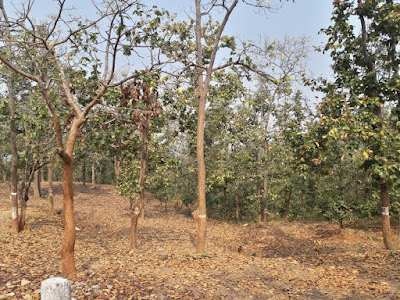
It is winter now in India and this is turning out to be cold one. The temperatures in Calcutta have reached unprecedentedly low levels and Siliguri is freezing, at levels that have not been seen for 5 years apparently. My wife tells me that the picnics parties are out in force in the Dooars and the forests are as pretty as ever.
This is something that I miss a lot in Malaysia. There is no winter!! In the heights of the Cameroon Mountains and Genting Highlands you do get a coolness that is soothing but it is not the same as winter in the plains. The advent of winter is something that I always used to look forward to in India. It was the time when you could go for long walks in the Dooars area, in the forest trails, the birds and the trees a marvellous backdrop to a satisfyingly tiring exercise. One of my favourite walks was the one from near the Khunia More Forest office near the Jaldhaka river on the Chalsa road and through the forests of the Chapramari division up to Murti. The walk is about 12 kilometers and the only drawback is that it is along a metalled road so that you are likely to meet cars and vans full of people going for a picnic, sometimes with loud music playing. Why a day out with nature must be accompanied by a loudspeaker and lots of alcohol is something I have never been able to figure out, but it has been the norm , at least in the Eastern part of the country for at least the last 40 years.
Anyway the walk is mostly solitary; the possibility of meeting a herd of elephants adds a frission of danger that adds to the enjoyment. There are so many birds that you can spend a week trying to spot and catalogue them and the trees are magnificent. There are two times of the year when the walk is specially good, One just after the rains when the forests are green and the undergrowth full of sounds of small animals that you never get to see. Another time is at the end of winter when spring is in the air and the Simul trees near Murti are in full blaze. I prefer to sit across the Murti Bridge and have my sandwiches sitting below a tree overlooking the river and the Simul blossoms. The next part of the walk is through a typical Bengali village, cultivated fields and then the Batabari tea estate to reach the Lataguri Chalsa road where a bus can take you back to Siliguri.
Another walk that we have taken all together as a family is the walk from Chalsa to Lataguri. This is also a wonderful tramp through the rich forests of Gorumara. Not at once, of course, we broke it up into three bits to cover the distance, using three Sundays for this purpose. On one occasion as we walked happily through a forested tract, some local villagers warned us that there was a herd of elephants ahead and we could hear them breaking branches in the forest. But try as we might we never got to see them! As both my wife and daughter were with me, discretion, I thought, was the better part of valour and we beat a retreat.
There are many other planned walks that I have not taken. What about walking from Khunia More upwards towards the hills? We had walked picnicked there once parking our car in one of the forest trails. The only problem in these areas is the ever present fear of elephants. This is something that should not be ignored. Elephants are extremely unpredictable creatures and are dangerous in a way that even tigers are not. In addition the increasing contact with hostile villagers and repeated confrontation with men have now made the North Bengal elephants a lot more dangerous than in the past. I never take risks with elephants.
The pleasures of forest walks are many and to my mind, the winter is the best time to enjoy these pleasures. While Malaysia has some of the most magnificent forests in the world, walking in these forests are not as pleasurable somehow. The constant sweating and dense undergrowth make it difficult to see animals and birds. Even so the trails in Taman Negara are wonderful and I have enjoyed our walks there. But winter? Winter never comes in the Malaysian peninsula!

Tuesday, December 29, 2009

Three cities in ten days

I am back from India after a holiday that seemed far too brief. I went back to Siliguri, now wracked by the Gorkhaland agitation. We had planned a short holiday in the hills but had to hastily cancel it as there was a bandh call, which in the event got cancelled. It is difficult to go for a holiday with the possibility of a Damocles sword hanging over you, no matter how beautiful the destination may be. Perhaps the agitators would do well to remember this. Once the golden goose is killed, there will be no more eggs, golden or otherwise.
Calcutta where we spent a couple of days was as Calcutta always is : dusty and crowded. I visited the Mohun Bagan ground after a long time and met Subir and his friends, of which I will write at length later. I saw the lights of Park Street, looking pretty good this year; it appears that the Park Street is recovering somewhat from the raggedness that it had fallen into during the eighties and the nineties. The roads as usual were chockablock with the most undisciplined traffic in the world. It never fails to amaze me that that the traffic is as unruly and chaotic as I have ever seen. In my 50 odd years of existence it has not changed a bit! Only I saw some better looking buses, sleek and with large windows. I unfortunately have become so cynical that my only thought was that this would not last too long, the next time I come to Calcutta I confidently expect them to have either disappeared or taken the specially Calcutta decayed look.
Chennai is where we next went and here we stayed for a couple of days. My family is still there; my wife is attending the annual conference of the anesthesiologists. The roads are better than Calcutta’s, but only the main ones. One autoride took us through some back lanes that rivaled even Bihar roads in the number of potholes. The autos here are famously crooked; no doubt they are members of some powerful union. And though I hate to criticise any city other than my own,I do feel that Chennai always seems to be too provincial. The local insistence of not being able to understand what you are saying, and a disregard for any cultures other than their own, labels it , in my opinion, a backwater, no matter how rich its indigenous culture may be. Also, a buffalo drawn cart, which we encountered, was a sight that is not seen even in Patna nowadays.
However Nalli’s sari shop which I have been visiting for the past two decades at regular intervals seems much the same as usual. I am intrigued at the number of women who are buying saris at 10 30 AM. The whole shop, all three floors of it is crowded. Surprise! One of the salesmen actually spoke to us in broken Hindi! Maybe even Chennai is changing! I remember the first time I came here you could get saris which cost from 25 to 10000 rupees. The lower limit has risen to Rs 65 I noticed , and the sky as usual remains the upper limit. Incidentally we bought our daughter her first sari here, so this visit was really special!
Flying to Malaysia from Chennai and Bangalore is a real pain. The flights are all at the middle of the night, so that you don’t get much sleep and it is really difficult to work the next day. I am getting too old for this, the next time I must come one day earlier, or take the Calcutta flight. It reaches here late at night, but at least you get to sleep in your own comfortable bed instead of Jet airways non reclining back seats( “ preselected for you sir”.) Though why I do not know considering that I had bought my tickets ages ago, I should have been entitled to something less than the worst seats I should have thought. The flight was absolutely full, in fact all the flights we took were fully booked up, the economy is certainly recovering.
Already, arriving at KLIA gives a feeling of homecoming. The brightly lit airport, familiar sights, the easy and comfortable taxi ride home makes me feel good. No hassles, no strikes, no shouting and yelling at the taxi line. Hey, is Malaysia seducing me with its charms?