Posts

Climate Change and Human Activity

William Ruddiman is a paleoclimatologist, that is somebody who studies the climate of long ago and how it influenced and even now influences the world today. He recently retired as the Professor of Environmental Sciences at the University of Virginia and is now the Professor Emeritus in the same department. He has long been known for a series of bold hypotheses about climate change. He was the man who in the 1980s postulated that the rising of the Tibetan plateau created the highly seasonal Monsoonal circulation which dominates the climate of South Asia today. However today he is best known for his controversial Ruddiman hypothesis. According to this hypothesis Human activity has been a basic and important factor in causing climate change not for the past two hundred years after the Industrial revolution released large amounts of fossil fuels and their byproducts into the atmosphere, but for the last 8000 years during which mankind has changed the face of many regions of the world. He ...
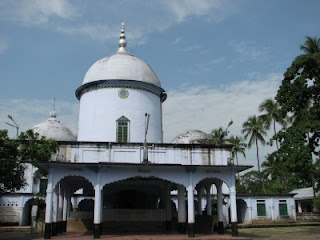
The Jalpesh Temple

Image
The Jalpaiguri district links the body of West Bengal to the North East. It lies north of Bangladesh, stretching from the foothills of the Bhutan Hills to the former princely state of Cooch Behar and then to Assam. The district town, Jalpaiguri lies on the East bank of the Teesta. Crossing the Teesta, the scenery is typically that of Bengal. Green paddy fields, ponds and large trees. Just to the north of the road to Cooch Behar lie the jungles of the Terai, home to the one horned Indian Rhinoceros. But here all is bucolic Bengal. The road to the Bangladesh border goes of at right angles from the Jalpaiguri Cooch Behar road and about 7 kilometers distant is the Jalpesh temple. The story of this temple begins in mythology. The Rangpur district, now in Bangladesh, was part of the kingdom of Kamrup in the days of the Mahabharata. The king of these parts, Baghadatta one of the Barman kings, sided with the losers in the battle of Kurukshetra and lost his life to the third Pandava, Arjun .Ho...

The Global Economic Crisis

The global economic crisis has struck and sob sob, all those poor flight crew who used to earn Rs 35000 a month are out of a job. The Times Of India informs me that they can now barely earn Rs 10000 a month in any other job. How will the poor souls make ends meet? And guess who are agitating for them? The CITU no less, in Kolkata and their twin, Raj Thackeray in Mumbai. And there is no reason the believe that Amar Singh or Jayalalithaaaaaa( Or however many a s she is using nowadays) will leap into the fray in no time. Please forgive me if I am not too sympathetic for these kids who were being paid at a level that even a doctor or a scientist with the highest qualifications are sometimes unable to earn. I know many many students of mine who would be glad to earn Rs 10000 a month and they are qualified doctors. The total lack of any sort of relationship between the type of work that a person does and the remuneration is something that shocks me. I am not surprised that the f...

Namieri National Park

The Pujas are here, and so , unexpectedly are we! In Siliguri I mean. For various reasons, mostly personal we are staying put in Siliguri this year instead of joining the usual Bengali emigration to other states and countries. Last year the Pujas were slightly later than this year and we visited Western Arunachal Pradesh, including the Tawang area. On the way back we turned away from the Bhalukpong Guwahati road to enter the wonderland of Namieri. We stayed at the Eco camp. This a is a collection of tents and some bungalows placed around a green. Run by Ronen Sen, a wildlife enthusiast and avid angler, this pace is really worth visiting. The Forest department has its camp just adjacent. Close to the camp is the entry to the Namieri tiger reserve and if you walk about a kilometer you come upon the Bhoreli river. The river reminded me of the Ramganga river at Corbet except that there was little evidence of human movement, though I am told, there is extensive poaching in this area. If y...

Health costs in India

It is commonly felt that hospitalization is the biggest financial burden that can befall a household. In many cases, poor people are financially crippled by a single hospitalization episode with the costs involved, loss of time at work and other costs( transportation, bribes and so on ) that they have to bear. However a new study suggests that so called minor illness episodes are more likely to cause an unacceptable burden to poor households in India. The study in question was published in the Indian Journal of Medical Research in April this year.The study has provided information in what is a very poorly researched field.I will summarize some of the principal conclusions. It is often claimed that the poorer parts of our population are sustained by indigenous medical practitioners. If this study is to be believed nothing is further from the truth. Just 3.2 % of the expenditure was made for these systems of medicine. While this may be due to the lower costs of indigenous therapy, t...

Death in the Dooars

Image
The Dooars are one of the most beautiful parts of India. As the tourist brochures say, it is full of lush forests, the second largest concentration of the one horned rhino, rippling streams, mountains and tea gardens. The tea gardens have been part of the landscape for about a hundred years. When you drive down towards Hashimara over the Coronation Bridge, they lie on both sides, lush green, full of shade trees and the workers with colourful baskets picking tea leaves- it is really a dream destination. Unfortunately it is also one of the killing fields of West Bengal. Until I came to live in Siliguri I had no idea of the poverty and disease that is rampant in these gardens. I first got an inkling of the state of affairs when some newspapers highlighted the starvation deaths that had taken place in the Tea Gardens of the Dooars. Unfortunately the attention span of the newspapers nowadays does not extend to two consecutive daily editions and the story was lost when we began to discu...

Snake Charmers

When we were children, snake charmers were a popular mode of entertainment. Together with bandarwalas and bhaloowalas, they entertained us hugely in those days when TVs did not exist and movies were a rare treat. Even in cities like Kolkata where we grew up, once in a while a snake charmer or a bandarwala would turn up and perform to huge popular acclaim. We were not aware, or did not care to see the cruelty involved in trapping and training these animals, nor did we ever think of the consequences of trapping snakes from the wild. We fully believed that the snakes we saw were poisonous and likely to bite at the least provocation. We were also convinced that the Sapura charmed the snakes by the music of the flute that he played. As we grew up we learnt that the animals were ill treated, the snakes were defanged and there was in fact no danger from these reptiles who only swayed to the movement of the flutes and could not in fact hear the music. I was reminded of all this when I read a...