The Man Killing leopards of Nagrakata Part 4
Reaching there would have been easy, maybe a 1-2 km distance if we could walk cross country and across the river, but with the car we have to retrace our steps to the main Highway, cross over to the Western bank of the Diana and then again turn southwards. The route is picturesque as we enter the forest. There are tea gardens, myriad streams and birds galore. We can, however, also see the devastation caused by the floods that occurred here in October. Houses have collapsed; some houses have parts missing or transformed into rubble. We reach a north south road and stop at the T junction and enquire about our next destinations.

Both the victims had lived in this stretch. We first drive
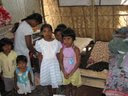
southwards to the house of Sushila Goala at Toribari. A bright young girl,
about 10 years of age, Sushila was bought up by her mother Puja, who is a
cultivator. She grows jute and paddy. Her eldest son is 18 years old she also
has one daughter aged 15. Sushila was her youngest. Their father is not here.
He is reportedly “mad” and spends much time wandering around the village and
its adjacent forests. Puja’s mother lives with them.

There is a pumpset close to their home where Sushila was washing clothes at about 5.30 PM on the 18th of October, 2025. A leopard who was hiding in the adjacent scrub jungle, attacked her and carried her off. The grandmother, who was close at hand, raised the alarm and her shouts brought out the local people who chased the leopard armed with sticks. The leopard had already torn the throat of the girl who was obviously dead. On being confronted,, the leopard climbed a tree, abandoning the victim. It threatened the gathering with growls and snarls, but by now a larger crowd had gathered and they began to burst crackers. This scared the leopard which descended from the tree and vanished into the adjacent forests. The child’s body was recovered and sent for post mortem.
Later the Forest Department laid traps in the nearby
forested land and about then days later, managed to trap a leopard which was
taken away. They also promptly arranged for the compensation amount of Rs 5
Lakhs.
Puja’s mother told us that living adjacent to the forest,
they were used to wildlife, even leopards. They took the occasional livestock,
but they could never have imagined that they would turn man killers. Now, the
villagers who used to roam the forests freely are scared of it. Nobody ventures
put after dusk unless in groups and children are corralled indoors as soon as
light begins to fade.
About 1 Km north of their house lived Asmit Roy. Asmit, one
of the two sons of Premila and Shatrughan Roy had one elder brother 17 years of
age. At about 6 PM on September 16th, 2025, Asmit and his friends
were playing football on a patch of land adjacent to the local Kali temple. The
game having ended, they were washing up at a tap nearby. His mother was not at
home, she had gone out to work. According to an eyewitness Sushanto Oraon, a 3
foot high leopard pounced on him and carried him off. A hue and cry ensued and
on being chased, the leopard abandoned the boy and was lost to sight in the
nearby jungle. Asmit was already dead.

On being informed the Forest Department officials retrieved
the body and took it for post mortem. The compensation amount of Rs 5 lakhs was
paid within a week.
Previous to the attack, they had heard the leopard calling
but there had been no sightings. The Forest Department traps which had been set
up nearby captured two leopards after about 25 days. The family has no toilet (so
much for NO open defecation programmes). They still go to the Jungle to relieve
themselves. However, precautions are being taken. Children are always
accompanied, especially in the early morning and evenings.
We drove back to the main road and had a long-delayed lunch
at a dhaba. We had to return to the Banarhat crossing to drop off Ardhendu and
then we returned to Siliguri.
Back in Nagrakata, at dusk, the Dooars returns to stillness quickly.
The Diana
contracts into quiet winter pools. Sal forests darken against the fading sky.
In labour lines, mothers call children indoors earlier than before. Men move in
groups after dark. Fires burn longer.
The leopard
moves by instinct — along cover, across riverbeds, through scrub and tea. It
does not recognise estate boundaries or compensation ledgers.
For
generations, coexistence here was uneasy but workable.
In the
Nagrakata belt today, that equilibrium feels fragile.
Forest and
home are not separated by walls — only by habit.
And in a
landscape under strain, habits are the first to change.

Comments