Posts

Interview: Sujata Mukherjee

Image
Sujata Mukherjee is now a well known name in medical journalism in West Bengal. She writes regularly on health issues in the column APNAR ASUKH SARAN in the Ananda Bazar Patrika and has written in all major Kolkata newpapers and magazines on the treatment of disease and its prevention. Many are surprised to know that Dr Sujata is not a medical doctor. She has a PhD in Chemistry; however her knowledge of medical matters is so good that she enjoys high credibility among her readers and is also respected by the medical fraternity because of her knowledge. She has written 10 books, her last, POKETE CHIKITSA 1st part and POKETE CHIKITSA 2nd part named EBAR SUNDAR HABO was published in 2011 and 2012 and immediately climbed to the best seller charts. Sujata and I go back a long way. We have been friends since 1990, if I remember correctly, when she first came to the Department of Cardiothoracic Surgery at the Medial College Hospitals where I then worked to write a story about it in BARTAMA...
The Bombing of Guernica

Image
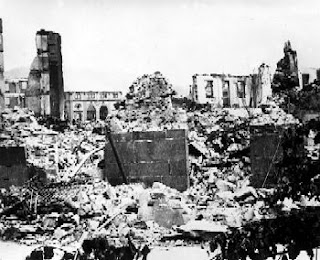
The Twentieth Century will probably go down in history as the century of Wars. There were the two world wars, the wars of liberation in Africa and China, civil wars in Nigeria and Ethiopia, but one war that lives on in the memories of men, was one that ended in defeat for the forces of Good and emphatically led to the victory of the dark forces. I refer, of course, to the Spanish Civil war. Fought as sort of prelude to the Second World War, between 1935 and 1939, this war pitted the forces of General Franco who represented the worst face of Conservatism against the elected government of the Spanish Republic. Ranged for the Franco forces were, of course, the Catholic Church, Nazi Germany and the Italian Fascists while the British gave them tacit support. The Republicans however mobilised support from all over the world and many young men from all parts of Europe and the Americas made their cause their own. One of them was Ernest Hemingway, whose novels paint a vivid picture of the st...

The Jenolan Caves

Image
Driving out from Sydney on a bright autumn morning, we were headed for the Jenolan caves. We, meaning, Aurelia, Sovan, Susmita and myself. The traffic was heavy as we left town, but soon, we were en route to the Blue Mountains, west of Sydney, the mountains that played an important part in the colonial history of Australia and formed the first natural obstacle to the colonizers as they attempted to penetrate to the centre of the continent. From the picture perfect town of Cootomba, the road to the Jenolan Caves branch off the main highway. The road is totally deserted this morning; we do not encounter traffic from either side. 40 kilometers on, the road winds steeply down, 8 kilometers of really steep mountain roads which lead to the magical Jenolan caves. These caves were known to the local Aboriginal community for thousands of years. They treated these caves as a tribal totemic area and reportedly avoided them. However they had named them 'Binoomea' (Dark Places). The fir...

Siliguri Transport: suggestions.Dr Nipon Haque and Dr John Sinha

Image
Around 4 years ago, I had written a blog post suggesting some solutions for the public transport situation in Siliguri. Recently, Nipon, he of the Nipowave and Bong Buzz fame, sent me a write up on his suggestions on the same topic which i have appropriated for this blog post. I have his permission. I also append a comment that Dr John Sinha, Nipon’s friend made on his post. Siliguri is a small but very important city considering its strategic location - being an important tourist transit point as well as the heart of North Bengal. But it will rank nowhere in the top list of small cities of India. In fact, it is a town at best, far from a city. I am sure that mere population doesn't make a city. A city needs some amenities which I am afraid are lacking here. Public transport being the worst! Even friends staying in Siliguri since birth find travelling from Hakimpara to Pradhannagar tiresome and "the distance too much". Without a decent transport system, Siliguri can ...

Satyendranath Bose, the Man Behind the Boson Part 3

Image
Satyen Bose in his seventies. ( Image: Google Images) Satyen Bose served in Dhaka for about 25 years. Here, he initiated a X ray Crystallography unit, even fabricating and designing his own equipment and did some excellent work on the structure of crystals. He also researched radio waves. As one biographer states” “In 1938 Bose investigated the problem of total reflection of radio waves in the ionosphere. It is said that it was M. N. Saha who induced Bose to look into this problem. To quote one of Bose’s colleagues Dr. Satish Ranjan Khastgir: “Prof. Saha had once come to Dacca from Allahabad. He gave a lecture in the Physics Department. He addressed a huge gathering at the Curzon Hall. Saha spoke these problems relating to reflection of radio waves from the ionosphere on which he was working. He asked his friend Bose to work out a solution for an intricate problem like this. Appleton had given three conditions for the reflection of radio waves; Saha introduced a fourth one based ...

Satyendranath Bose, the Man Behind the Boson Part 2

Image
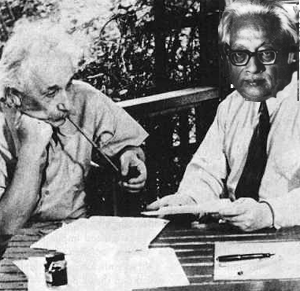
Bose and Einstein In Berlin: Image courtesy: Google Images. The Dhaka University was founded in 1921 and he was invited to join the Physics Department there as a Reader. It was a wrench for him to leave his beloved Kolkata as his grandson has recorded, but he did decide to take up the post and he wrote to his friend Meghnad Saha from there ( Saha hailed from that part of Bengal) “ it has been well over a month since I moved to your part of the country. Work has not yet started. Your Dacca College had quite a few things but due to utter neglect they are in a bad way. Perhaps I need not elaborate. On the table of the sahibs are scattered lots of Nicol prisms, lens and eye-pieces. It would require a lot of research to determine which one belongs to which apparatus. We do suffer from lack of journals here, but the authorities of the new university have promised to place order for some of them along with their back numbers. Talk is going on about having a separate science library.” Ho...

Satyendranath Bose, the Man Behind the Boson

Image
Satyen Bose as a young researcher. ( Image courtesy: Wikepedia) This is part of a fairly long article on Satyendranath Bose, one of the long list of men and women who made Kolkata what it was in the nineteenth and twentieth centuries. I have broken it up into three parts. The other parts will be posted in subsequent weeks. I had a friend who used to claim that when walking towards his North Calcutta home on his way back from school, he often used to notice a senior citizen with a thatch of white hair sitting on the verandah of one of the houses of the locality. He never realized that this man was none other than Satyendra Nath Bose, whose name has been immortalized in science by the particle boson and who together with Einstein developed the Bose Einstein statistics which revolutionized the study of small particles. Bose was born in Kolkata on New Year’s Day in 1894. Their ancestral home was in the Nadia district. His father, Surendranath Bose worked for the East Indian Railw...