Posts

Travel Tales Part 4

Image
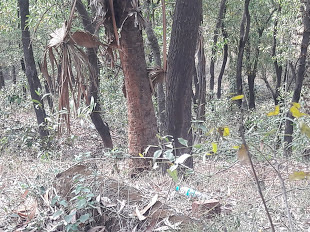
Gopegarh really came to its own after 5 PM. That was when all the day-trippers departed and the entire park was left to us, the only two boarders and the few staff who manned the canteen and looked after the park proper. Imagine living in a wilderness of about 5 square miles, full of forests, ravines and a lake and you are free to explore it at your own pace with not another human in sight. I guess I now knew how the owners of landed estates felt when they surveyed their domain. Part of the forest  The Forest authorities have created a trekking trail which takes you through a fairly dense stretch of forest which has been left relatively undisturbed. This short walk, perhaps a couple of kilometers starts near the bungalow and ends up near the ruined fort and takes you down to the gullies that have been carved out of the laterite soil by the Kangsabati river and then up again to the sort of plateau I which most of the park is located. Opposite to this is a lovely sal fores...

Travel tales Part 3

Image
As I have mentioned earlier, we had not made any plans whatsoever. Not for us the mundane details of planning our route or our accommodation. Swapanda had assured me that he had a map of the undivided Midnapur District, a detailed map that we would use to plan our further course journeys.   Unfortunately when Swapanda opened the map at Midnapur station we discovered that he had packed the map of Madhya Pradesh instead. This too was a map dating back to those days before Chattisgarh had been separated from the state. Unless we planned to go back to Kharagpur and take a Mumbai bound train and I am not saying that we did not consider it for some moments, we had no option but to pack it away at the bottom of Swapanda’s bag and depend upon good old Google Maps. In the event, it served us well. The Main gate ( taken from  the Outlook website)  The Gopegarh Ecopark was opened to the public in 2000. It is a large area, exactly how large; I am unable to say as I was un...

Travel Tales Part 2

Image
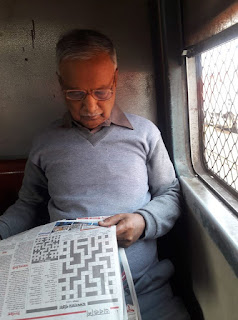
But these were as trifles. The weather was delicious: cool, but not too cold, the sun was pleasant and the Red Silk cotton was in bloom. Of the flowers which make the Bengal spring so delightful, the red silk cotton is perhaps the first to flower. The trees are totally leafless but the blood-red blooms are on every branch. The space below is often carpeted with red and the flowers are powerful magnets for a large variety of birds. On or two “madar” trees were also blooming I noticed, but the palash trees, not so common In Howrah District, were yet to blossom. There is something that makes me very nostalgic when I travel by a local train, or more specifically by the EMU coaches. It reminds me of many journeys made in my childhood to Krishnanagar to visit my grandparents, of journeys, made just to see the green fields when we tired of Kolkata and of our journeys to small stations in Jharkhand and Purulia with our rucksacks en route to a camping holiday. Babusona and his gamchas ...

Travel Tales Part 1

Image
Traveling soothes me. Ever since I can remember I liked to travel. Time was when we traveled rough and light. We took local trains, buses, stayed rough, in lodges I would not be seen dead in today, and ate in all sorts of places from which I would recoil in horror today. And then we walked. We have walked in the Himalayas; twice a year, every year for more than 20 years. We have walked in the plains; we have walked along the coast. But in recent times, my travels have become a tad more bourgeois. I mostly fly to my destination, take a car for the last mile and stay in as much luxury as I can afford. Not for me the rigours of train travel, sleeper class or otherwise. During my trekking days, I had acquired some companions who became my bosom friends. Over the years we have all aged, some have grown old and others have died. Of the 6 of us who went to Everest Base Camp and climbed the Kala Patthar, only 4 remain. Asit da and Borda( or Mastermoshai) as we knew them have gone on to th...

Siliguri Sunday Haat is One Year Old

Image
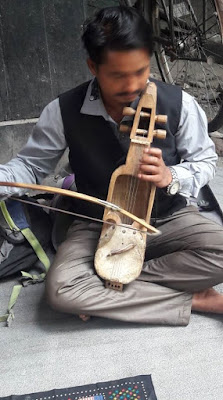
For the past year, Siliguri has had a haat (periodic village market). Called the Sunday Haat, this takes place on Church Road every week. In collaboration with COFAM   (Centre for Floriculture & Agro-business Management) – NBU (North Bengal University), the Mango tree Village Haat holds a market that enables the producers of organic produce as well as makers of handicrafts to display and sell their products. The Haat runs from 10 Am to 2 PM every Sunday. I had visited the Haat the last time I was in Siliguri in October. One of the chief organizers and an inspiration for this haat is my friend Raj Basu. ( You can read an interview with him here ) He had asked me to come and have a look at what was being done and I was very impressed. On the particular day that I had attended it, there was. in addition to all the fresh vegetables and fruit, jam, condiments and what not, a group of itinerant singers from Nepal. They added a cultural dimension to the Haat and to tell ...

2020 and all that

Image
2020 has arrived. It was to be the year when India became a developed country. It was to be the year when we arrived as a major player in the world and when India became a beacon of hope for countries with religious and regional divisions to look up to and feel confident that this was the model that should be used in order to have a democratic, tolerant and vibrantly diverse path to prosperity. Alas, the year dawned a few days ago and it has been heralded by a gasping economy, deep divisions exacerbated by those in power and unrest and violence everywhere. The sellers of dreams are still promising jam tomorrow. The state of the republic leaves much to be desired to put it mildly. Is everything lost? That is what I would have thought until the country fought back over the past month or so. It warms the cockles of my heart to see that students and young people are standing up to be heard and saying no to the narrative that appeared to be unchallenged over the past few years. The...

Hate Speech and Fake News: Then and Now

Image
I was reading Umberto Eco’s novel The Prague Cemetery. This very cleverly constructed novel uses actual historical characters who interact with the fictional narrator of the book. It is a riot of intrigue and what would today be called fake news. The manner in which Jews, communists and other rebels were demonized by the creation of false documents is eye opening. That such tactics are still in use goes without saying. What struck me was how old and well tested the tactics are and how well they work. Verily, there is nothing new under the sun. In one passage, a Russian agent advises the narrator about how one can deflect discontent from the authorities to other “enemies of the people”. The tactics described so perfectly described those of the present ruling dispensation in India, Russia, Turkey and of course the US and UK, that I think it bears quoting at length. If you just substituted some words, mainly “Muslims” for Jews, it would be a blueprint for the right wing nation...